
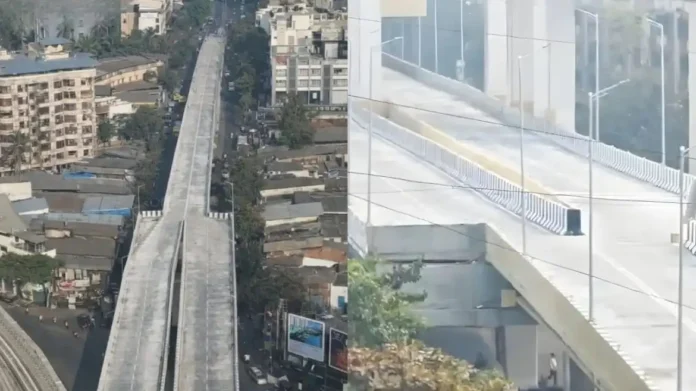
A viral video of a newly built double-decker flyover in Mira-Bhayandar, Mumbai, appearing to narrow from four lanes to two lanes abruptly, has triggered widespread criticism and political jabs in late January 2026. Shared on X and quickly amplified by opposition leaders, the clip has raised serious questions about infrastructure planning, safety, and accountability in one of India’s busiest metropolitan regions.
The flyover, part of Mumbai Metro Line 9 (Dahisar-Mira Bhayandar-Bhayandar West corridor) constructed by JKumar Infraprojects, is set for inauguration in February 2026. An aerial view shows the structure starting wide for four lanes but seemingly squeezing into just two, prompting netizens to call it an “engineering disaster” and “an invitation to crashes.”
The Viral Video & Public Outrage
The footage, first posted by X handle Gems of Mira Bhayandar (@GemsOfMBMC) on January 26, 2026, shows the flyover’s ramps transitioning sharply. Caption:
“A 4-lane flyover in Mira-Bhayandar suddenly narrows into just 2 lanes. This double-decker flyover is a part of the Metro Line 9 project by JKumar and is set to be inaugurated in February. Is this how @MMRDAOfficial designs ‘infrastructure’? How did this design get approved?”
The post exploded, gaining massive traction. The Indian National Congress reposted it on January 27, 2026, with sarcasm:
“महाराष्ट्र में इंजीनियरिंग का ‘चमत्कार’ 👇 एक फोर लेन ब्रिज अचानक से दो लेन में बदल गया। महाराष्ट्र हो या मध्य प्रदेश- BJP सरकार में ऐसे जानलेवा ‘चमत्कार’ आम हो चुके हैं।”
(Translation: “Engineering ‘miracle’ in Maharashtra… BJP governments make such deadly miracles common.”)
Aditya Thackeray (Shiv Sena (UBT)) mocked:
“Very true. People must not make fun of MMRDA… Next year, another MoU on teaching this design to other countries.”
Netizens piled on with memes: “Expectation vs Reality,” references to Cyrus Mistry’s fatal accident on a similar “L-shaped” design, quota jabs, and quips about “Amrit Kaal” engineering. Concerns ranged from safety risks (sudden lane drops causing accidents) to poor planning and contractor accountability (JKumar’s past projects, like the Mumbai-Pune highway, were criticised).
MMRDA’s Official Response: Not a Flaw, But Planned Design
The Mumbai Metropolitan Region Development Authority (MMRDA) responded swiftly on January 27, 2026, via X:
“The flyover does not ‘suddenly narrow’. The transition from 4 lanes to 2 lanes is not a design flaw, but is based on available road width constraints, and future network planning.”
Key points from MMRDA’s detailed clarification:
- The flyover is designed as 2+2 lanes up to Golden Nest Circle (one of the busiest junctions), integrated with Metro and slip roads for traffic dispersal.
- Bhayandar East arm comes first in alignment → current 2 lanes for it.
- The remaining 2 lanes are reserved for future extension across the Western Railway line to Bhayandar West.
- Road width constraints (right-of-way limits near Railway Phatak Road) prevent full 4 lanes now.
- Future widening: Outer sides of both carriageways to add a 1+1 lane (in planning with Mira-Bhayander Municipal Corporation after approvals).
- Safety measures: Rumble strips, delineators, signage, retro-reflective markers, anti-crash barriers; traffic police guidance before opening.
MMRDA emphasised:
“This design enables smooth crossing of one of the busiest junctions… while accommodating on-ground constraints.”
Why This Design? Technical & Practical Reasons
Experts and MMRDA explain:
- Alignment priority: Bhayander East traffic gets immediate access; West extension planned later.
- Land/ROW limits: Insufficient space for full 4 lanes due to existing roads, railways, and urban density.
- Phased construction: Common in India due to cost, land acquisition delays, and future-proofing.
- Traffic management: 2+2 with slip roads handles current flow; full widening later avoids major disruptions.
Similar designs exist elsewhere (e.g., the Hebbal flyover in Bengaluru had initial bottlenecks resolved by extensions).
Broader Implications: Safety, Politics & Infrastructure Woes
The controversy highlights recurring issues in Indian infra projects:
- Safety risks: Sudden lane drops can confuse, braking issues, and accidents (especially at high speeds).
- Political angle: Opposition (Congress, Shiv Sena UBT) attacked the BJP-led Maharashtra government for “deadly miracles” and lack of accountability.
- Public trust: Viral memes and comparisons erode confidence in agencies like MMRDA.
- JKumar scrutiny: Past criticism of Mumbai-Pune highway quality adds fuel.
No accidents reported yet, but netizens demand better signage and audits before the February inauguration.
This is an “engineering marvel” or “bottleneck”? MMRDA insists it’s planned – but public scepticism lingers. Share your thoughts – safe design or disaster waiting? 🚧

