
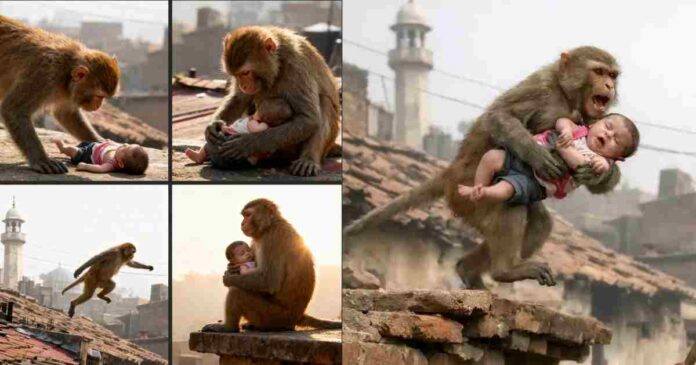
In a heart-stopping incident from Bihar, a one-and-a-half-month-old baby was snatched by a monkey, but quick-thinking villagers managed to rescue the infant unharmed by using a clever distraction tactic—throwing rotis (Indian flatbreads) to lure the primate away.
The dramatic rescue has garnered attention on social media, with many praising the villagers’ presence of mind during the terrifying ordeal. Unlike many tragic monkey-snatching incidents across India that have ended in fatalities, this case had a miraculous outcome thanks to the community’s swift and intelligent response.
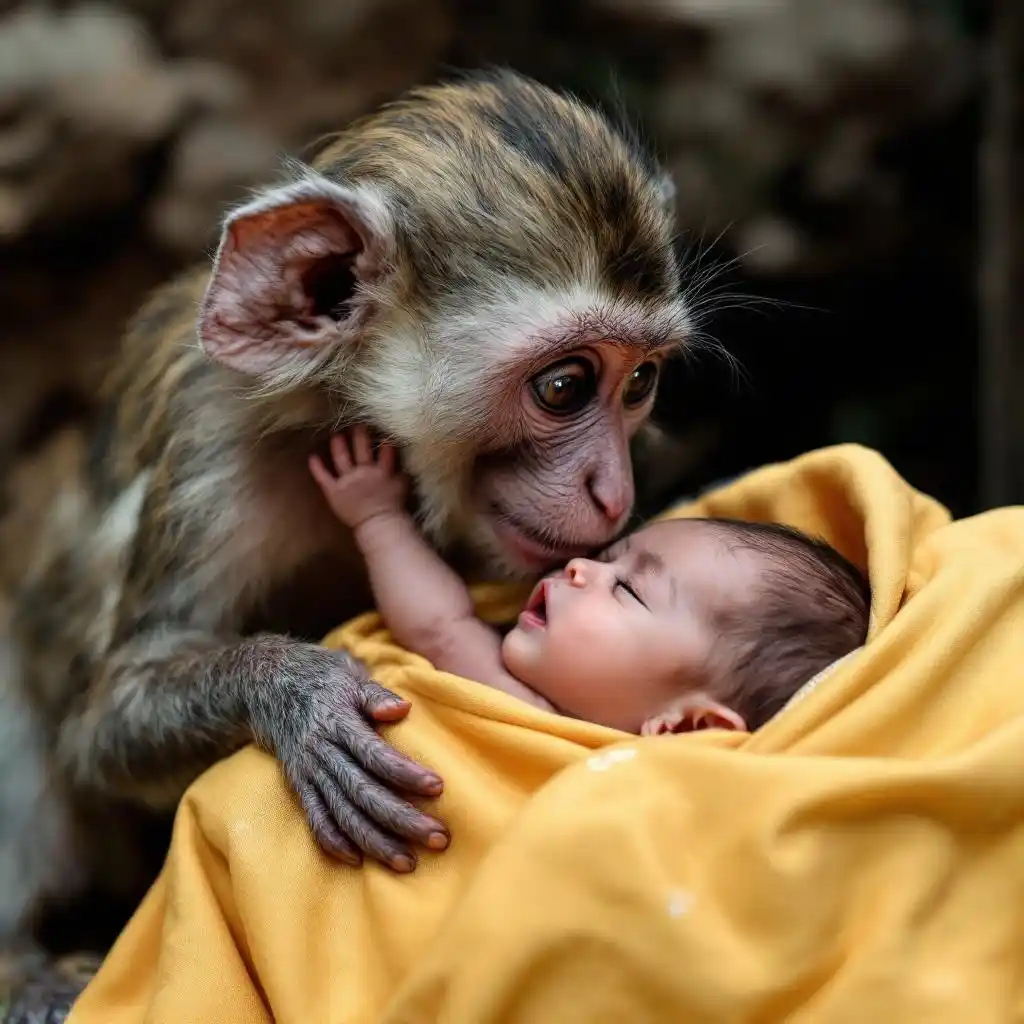
How the Rescue Unfolded
According to the Economic Times report, the incident took place when a monkey suddenly grabbed the 1.5-month-old infant. As panic spread among the family and neighbours, the villagers quickly devised a plan to rescue the baby without agitating the monkey further.
Understanding that monkeys are often motivated by food, the villagers began throwing rotis in the monkeys’ direction. The food proved to be an effective distraction—the monkey released its grip on the baby to grab the rotis, allowing the villagers to retrieve the infant safely.
The baby was rescued without any serious injuries, much to the relief of the terrified parents and the entire village.
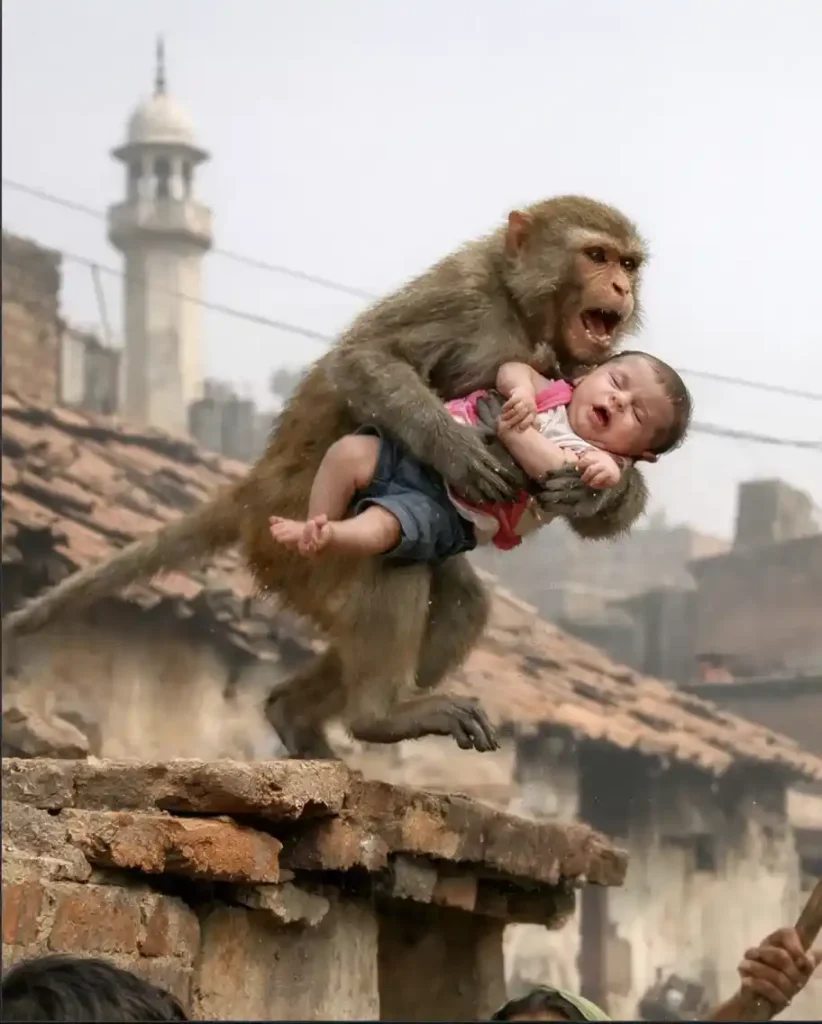
Why the “Roti Trick” Worked
The villagers’ strategy was based on an intuitive understanding of animal behaviour:
| Factor | How It Helped |
|---|---|
| Monkeys are food-driven | Primates often snatch items when hungry; food can redirect their attention |
| Non-aggressive approach | Throwing food avoided provoking the monkey into harming the baby |
| Distraction over confrontation | Direct attempts to grab the baby could have made the monkey flee with the infant |
| Community coordination | Multiple people working together ensured quick, effective action |
😰 India’s Growing Monkey Menace: Why This Rescue Is Remarkable
This incident highlights the ongoing human-wildlife conflict in India, particularly involving monkeys. While this case had a happy ending, many others have been tragic:
A 4-month-old baby from India was killed after reportedly being kidnapped by a gang of monkeys and thrown from a three-story roof. A family of three said they were relaxing on the roof of their home in Bareilly, India, when a group of monkeys attacked.
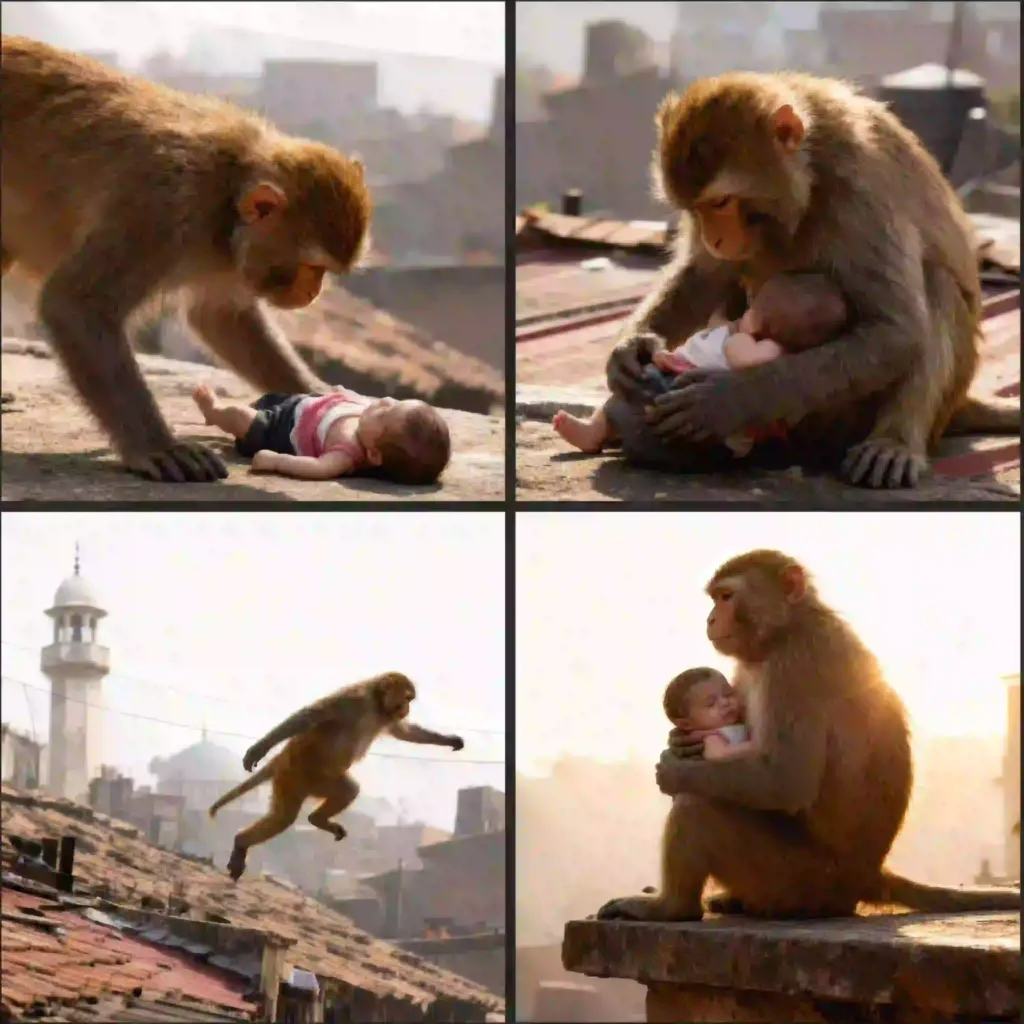
Authorities in India searched for a monkey that snatched a newborn baby from a house in the village of Talabasta, Orissa. A relative found the 16-day-old baby dead in a well near the house. “The baby was sleeping next to its mother when the monkey allegedly carried him away. The mother immediately raised cries for help but the creature fled with the baby and disappeared from her view,” a local police officer said.
A 12-day-old baby died after a monkey snatched him from his mother and left him bruised and bitten on the terrace of a neighbour’s house in Agra.
In a recent incident, a 20-day-old newborn girl cheated death after being snatched from her mother’s arms by a monkey and thrown into an open well in Sevni village of Chhattisgarh’s Janjgir–Champa district.
📊 Monkey Attack Statistics in India
Monkey-related deaths are not uncommon in certain places of the world, especially India.
Wild monkeys, who roam free around towns, are often caught causing damage to property and stealing food, but cases of violence were previously considered “very rare.” However, police noted that “while monkeys attacking humans or entering houses in search of food are fairly common, this is the first case in which one has run away with a baby.”
Why Do Monkeys Snatch Babies?
Experts have offered various explanations for this disturbing behaviour:
Eco-activist Shravan Kumar said that monkeys are becoming increasingly aggressive as their natural habitats have been destroyed and the green cover is steadily shrinking.
Residents in affected areas say monkeys loot, snatch and attack people, particularly women and children. “People do not dare to go to their terraces. Those who do have sealed their homes with iron mesh cages. You cannot leave your door open or sit in the sun,” said one resident.
Other factors include:
- Habitat destruction is forcing monkeys into human settlements
- Easy food availability in residential areas
- Population explosion of urban monkeys
- Curiosity about small, helpless creatures
- Possible maternal instinct (female monkeys may mistake human infants for their own)
How to Protect Babies from Monkey Attacks
Based on expert recommendations and lessons from past incidents:
| Precaution | Details |
|---|---|
| Never leave babies unattended | Especially outdoors or near open doors/windows |
| Secure entry points | Use mesh screens on windows; keep doors closed |
| Avoid rooftops with infants | Many attacks occur on terraces |
| Don’t feed monkeys | It encourages them to approach humans |
| Keep food stored | Open food attracts monkeys to homes |
| Use distraction if confronted | Throw food AWAY from the baby to lure the monkey |
| Never chase aggressively | It may cause the monkey to flee with the child |
The Viral Story: Community Heroes
The story of the rescue has been widely shared, with netizens praising the villagers:
Social Media Reactions:
- 💬 “This is why community matters! Quick thinking saved a life”
- 💬 “The roti trick is genius—fight food obsession with food!”
- 💬 “Thank God for these brave villagers. This could have ended so differently”
- 💬 “Every parent in monkey-prone areas should know this trick”
- 💬 “Humanity at its best—simple, smart, effective”
Bihar: A Hotspot for Human-Monkey Conflict
Bihar, like many states in North India, has seen increasing human-monkey conflicts due to:
- Expanding urbanisation encroaching on forest areas
- Monkeys adapting to human settlements
- Religious sentiments protecting monkeys (associated with Lord Hanuman)
- Lack of effective wildlife management programs
A rescue team was constituted and started in Sanjay Gandhi Biological Park, Patna since 2015. The objective of this team is to provide support to DFOs and other departments to help them in rescuing strayed wild animals. This team has a total of 5 persons, including the monkey catcher, snake charmer, driver, veterinary doctor and compounder.

