
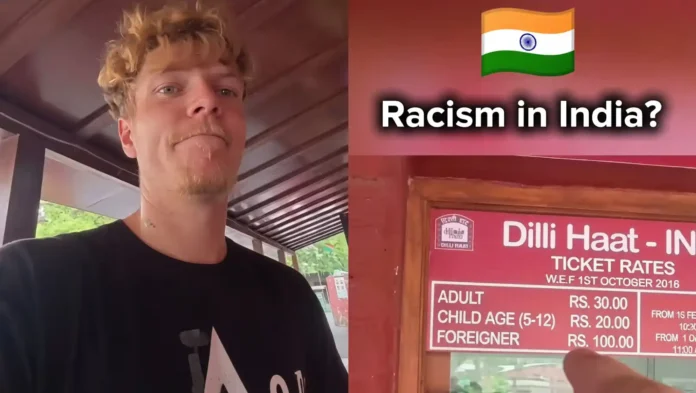
A foreign tourist’s video questioning the higher entry fee for international visitors at Delhi’s popular Dilli Haat has triggered a sharp online debate. The visitor labelled the price difference as “racism,” but a large section of internet users strongly rejected the comparison.
Tyler Blunden shared a video from the ticket counter at Dilli Haat. The board clearly showed different rates: ₹30 for Indian adults, ₹20 for children aged 5-12, and ₹100 for foreign visitors.
What the Tourist Said
In the video, Blunden pointed to the board and said:
“Look at that, guys. I’ve got to pay a different price from everybody else. If they did that in the UK, that would be called racism. But here, it’s alright.”
The video was also captioned with the words “Racism in India?”
Strong Pushback from Netizens
The remarks quickly drew mixed but largely critical reactions. Many users pointed out that differential pricing for foreigners is common across the world and does not amount to racism.
Several comments highlighted higher fees charged to international students at universities in Western countries. One user asked, “So foreign universities charging double fees to international students is racism?” Another wrote, “Have you checked the tuition fees in your university? They have a separate section called international students that charges way more than what locals pay. So tit for tat.”
A third user noted, “Indian students pay 3 times the fees in Western countries and are still being attacked.” Others argued that the difference in disposable income should be taken into account. “If paying less than 1 Euro for you feels like racism then why do you guys charge 3x more to students who want to come to your nations… most of the Indians have much smaller disposable income than Europeans,” one person wrote.
Public Funding Argument
Some commenters offered a different explanation. They said places like Dilli Haat are maintained with public funds and taxes paid by Indian citizens, which is why locals are charged a lower fee.
“It’s so basic. This place is maintained by the taxes of Indians. That’s why Indians have to pay less,” one user commented.
Others pointed out that similar dual pricing exists in Europe as well, where non-EU tourists are often charged extra at many attractions.
Broader Context
Differential pricing for domestic and foreign tourists is a long-standing practice at many monuments, museums, and cultural sites in India and several other countries. Supporters of the system argue it helps make cultural spaces more accessible to local citizens while generating additional revenue from international visitors who generally have higher spending power.
Critics of dual pricing, on the other hand, sometimes call it unfair. In this case, however, the majority of online reactions rejected the racism label and defended the existing structure.
The viral exchange has once again brought the topic of dual pricing into public discussion. While the tourist viewed the higher fee as discriminatory, many Indians saw it as a practical and widely accepted system used in multiple countries.
What do you think — is differential pricing for foreigners fair, or should entry fees be the same for everyone? Share your views in the comments below! 🎫

