
Earning ₹30,000 per month and feeling like nothing is left at the end of the month? You are not alone. Most salaried Indians in this income range struggle to save even ₹1,000 monthly. The good news: with the right plan, you can save ₹8,000–₹10,000 every month on a ₹30,000 salary — without living like a monk.
In this guide, you will learn exactly how to save money on a 30000 salary in India, with a real monthly budget breakdown, practical tips, and investment options that work in 2026.
I know this struggle personally. My first job in Pune paid me ₹28,500 in hand, and for the first six months I saved exactly zero rupees. It wasn’t until I moved into a shared 2BHK with two colleagues and started cooking dinner at home that I saved my first ₹5,000 in a single month. That one change taught me more about money than any finance book.
Quick Answer: How Much Can You Save on ₹30,000 Salary?
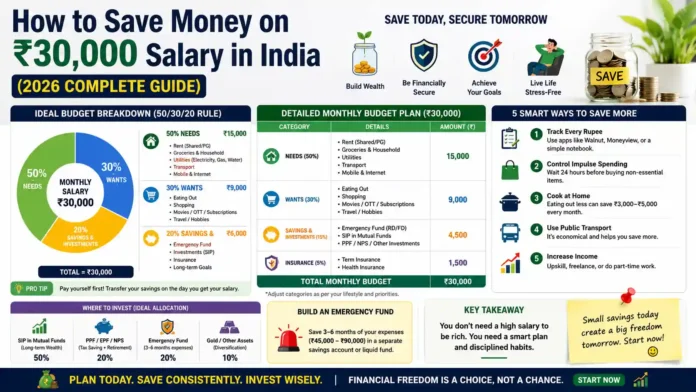
Using the 50-30-20 rule, here is the ideal split:
| Category | Percentage | Amount (₹) |
|---|---|---|
| Needs (rent, food, bills) | 50% | ₹15,000 |
| Wants (entertainment, shopping) | 30% | ₹9,000 |
| Savings & Investments | 20% | ₹6,000 |
With a few smart adjustments (covered below), you can push savings to ₹8,000–₹10,000 per month, which becomes ₹96,000–₹1.2 lakh per year.
Step 1: Create a Realistic Monthly Budget
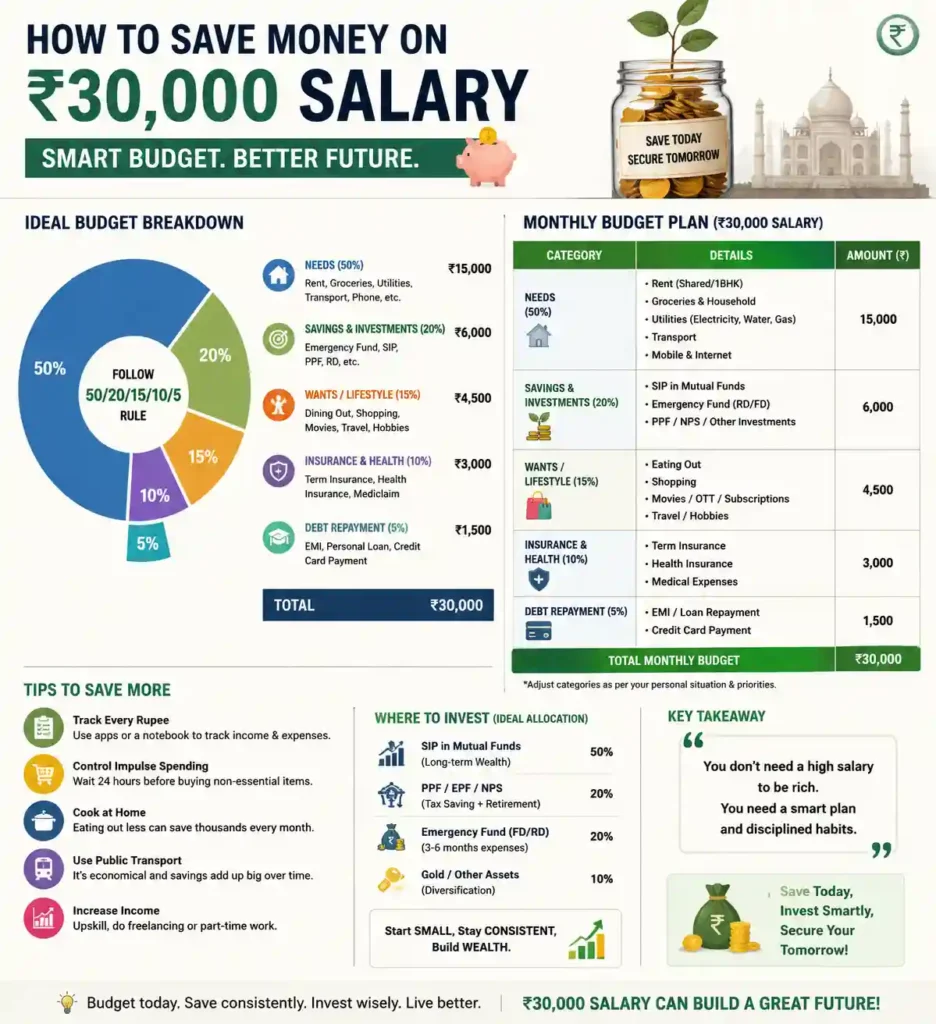
Here is a sample monthly budget for someone earning ₹30,000 in an Indian metro or tier-2 city:
| Expense | Metro City (₹) | Tier-2 City (₹) |
|---|---|---|
| Rent (shared/1RK) | 8,000 | 5,000 |
| Groceries & food | 5,000 | 4,000 |
| Transport | 2,000 | 1,500 |
| Mobile & internet | 500 | 500 |
| Electricity & utilities | 1,000 | 800 |
| Entertainment & eating out | 3,000 | 2,500 |
| Miscellaneous | 2,000 | 1,700 |
| Total Expenses | 21,500 | 16,000 |
| Savings Possible | ₹8,500 | ₹14,000 |
Key takeaway: Track every rupee for one month using a free app like Walnut, Money Manager, or even a simple Google Sheet. You cannot save what you cannot see.
Step 2: Cut These 7 Expenses First (Save ₹5,000+ Monthly)
In my case, I was spending nearly ₹4,200 a month on Swiggy without realising it — I only found out when I checked my order history. Now I order food only on Saturdays, and that one rule alone saves me around ₹3,000 every month.
- Share your rent – Moving from a 1BHK (₹12,000) to a shared flat (₹7,000–8,000) saves ₹4,000–5,000 instantly. This is the single biggest saving on a ₹30,000 salary.
- Cook at home 5 days a week – Ordering food costs ₹200–300 per meal. Cooking costs ₹50–70. Save ₹2,500+ monthly.
- Cancel unused subscriptions – Do you really need Netflix, Prime, Hotstar AND Spotify? Keep one, share family plans. Save ₹500–800.
- Switch to a cheaper mobile plan – Annual prepaid plans cost less than monthly recharges. Save ₹100–200 monthly.
- Use public transport or a second-hand two-wheeler – Daily cab/auto rides eat ₹3,000+ monthly. Metro/bus pass costs under ₹1,500.
- Avoid EMI purchases – A ₹1,500 monthly EMI on a phone is ₹1,500 you cannot save. Buy within budget, in cash.
- Set a UPI spending limit – Small ₹100–200 UPI payments add up to ₹2,000–3,000 monthly without you noticing.
Step 3: Automate Your Savings (Pay Yourself First)
The trick that finally worked for me: I set my SIP auto-debit for the 2nd of every month, one day after salary. Since the money leaves before I even see it, I’ve never once “forgotten” to save in the last two years.
The biggest mistake people make: saving whatever is left over. Instead, save first, spend later.
- Set up an auto-debit SIP of ₹3,000–5,000 on your salary day (1st or 2nd of the month).
- Move ₹2,000 to a separate savings account you don’t touch.
- Whatever remains is your actual spending money.
Step 4: Where to Invest Your Savings in 2026
On a ₹30,000 salary, keep it simple:
| Option | Monthly Amount | Why |
|---|---|---|
| Emergency fund (savings account/liquid fund) | ₹2,000 | Build 3–6 months of expenses first |
| Index fund SIP (Nifty 50) | ₹3,000 | Long-term wealth, ~12% average returns |
| PPF | ₹1,000 | Tax-free, safe, 7.1% interest |
| Term insurance (if you have dependents) | ₹500–700 | ₹50 lakh–1 crore cover, very cheap at a young age |
Example: A ₹3,000 monthly SIP for 15 years at 12% returns grows to approximately ₹15 lakh — from just ₹5.4 lakh invested.
Step 5: Increase Your Income (The Other Half of Saving)
Saving has a limit; earning does not. On weekends or evenings, try:
- Freelancing – content writing, graphic design, data entry (₹5,000–15,000/month extra)
- Online tutoring – teach school subjects or spoken English
- Selling a skill – video editing, social media management for local shops
- Upskilling – a free/cheap certification can get you a 20–30% salary hike at your next job switch
Even an extra ₹5,000 per month doubles your savings rate.
Common Mistakes to Avoid on a ₹30,000 Salary
- Taking personal loans or credit card debt for lifestyle purchases
- Buying a new bike/car on EMI in your first years of earning
- Investing in “get rich quick” schemes, crypto tips, or trading without knowledge
- Not having health insurance — one hospital bill can wipe out years of savings
FAQs
How much should I save from a ₹30,000 salary?
Aim for at least 20% (₹6,000) per month. With controlled expenses, ₹8,000–10,000 is achievable, especially in tier-2 cities.
Is ₹30,000 a good salary in India?
Yes — it is above the median Indian salary. In tier-2/3 cities, it allows a comfortable life with strong savings. In metros, budgeting is essential.
Can I invest in SIP with a ₹30,000 salary?
Absolutely. You can start a SIP with as little as ₹500. A ₹3,000 monthly SIP is ideal for this income level.
How can I save ₹1 lakh in a year with a ₹30,000 salary?
Save ₹8,400 per month. Achieve this by sharing rent, cooking at home, avoiding EMIs, and automating a SIP on salary day.
Should I save or repay loans first?
Repay high-interest debt (credit cards, personal loans) first, build a small emergency fund, then start investing.
Also, Read How to Start SIP with 500 Rupees in India (2026 Step-by-Step…
Final Thoughts
Honestly, the first two months of budgeting felt restrictive. But by month three, I had ₹17,000 sitting in my account — more than I had saved in the entire previous year. That feeling is addictive in the best way.
Saving money on a ₹30,000 salary in India is 100% possible — it just needs a system, not sacrifice. Start with the 50-30-20 rule, automate a SIP on salary day, cut your top 3 expenses, and slowly grow your income. In 12 months, you will have ₹1 lakh+ saved and a habit that lasts a lifetime.
Start today: open your banking app and set up a ₹2,000 auto-transfer for your next salary day. That one action is worth more than reading ten articles.

