
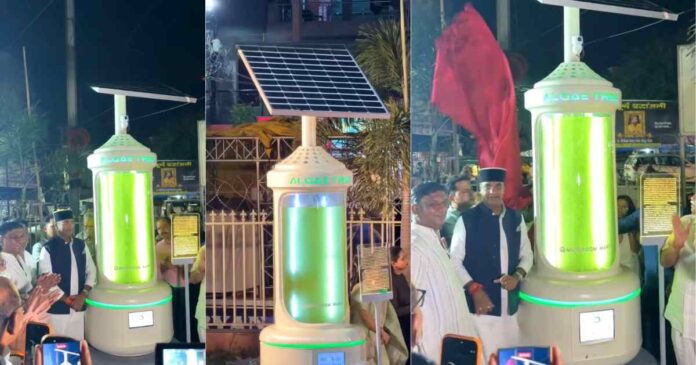
In a groundbreaking step towards combating climate change, Bhopal has introduced India’s first algae tree — an innovative carbon-capturing unit that is said to be as effective as 25 normal trees. This eco-friendly technological marvel has caught the attention of environmentalists, scientists, and citizens across the country, with many hailing it as a smart and sustainable solution for urban pollution.

The algae tree is not a traditional plant but a specially designed vertical structure filled with microalgae. These microscopic organisms are highly efficient at absorbing carbon dioxide (CO₂) from the atmosphere and releasing oxygen through photosynthesis. Unlike regular trees that take years to grow and mature, this algae-based system starts working effectively almost immediately and requires significantly less space.
How the Algae Tree Works
The unit consists of a tall, vertical bioreactor system containing live algae culture. As polluted air passes through the structure:
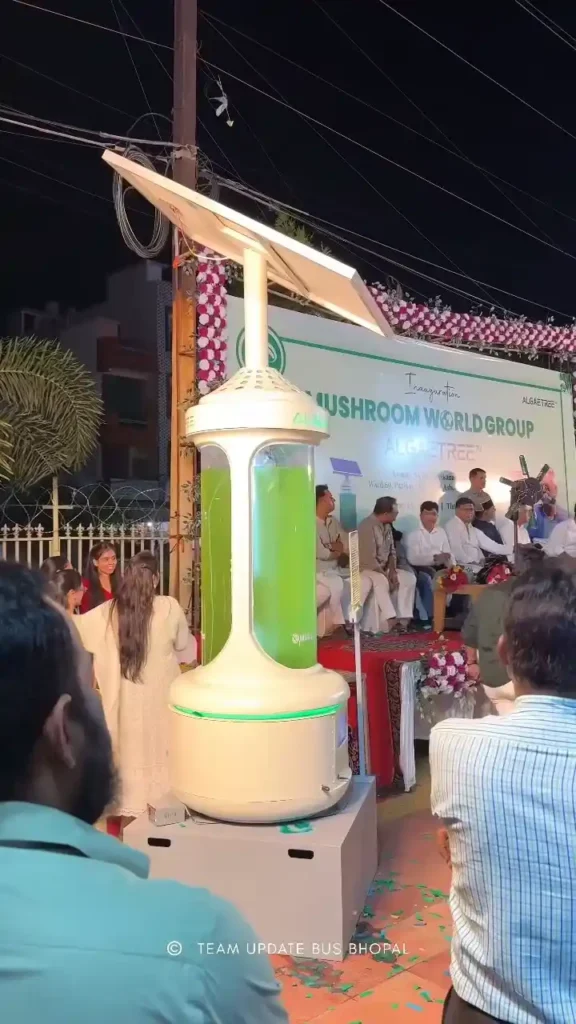
- Algae absorb large amounts of CO₂ and other harmful pollutants.
- They convert it into biomass and release fresh oxygen.
- The system is designed to be low-maintenance, with periodic harvesting of algae biomass that can be used for various purposes like biofuel, animal feed, or organic fertiliser.
According to developers, one such algae tree can capture carbon equivalent to what 25 mature trees would do over the same period, making it highly efficient for densely populated urban areas where planting large numbers of trees is challenging due to space constraints.
Why This Innovation Matters
Urban centres like Bhopal face rising air pollution levels due to traffic, construction, and industrial activities. Traditional afforestation methods, while important, are often slow and require large land areas. The algae tree offers a compact, high-efficiency alternative that can be installed in parks, road dividers, rooftops, and commercial complexes.
Key advantages include:
- Much faster carbon sequestration rate
- Minimal water requirement compared to traditional trees
- Ability to function effectively in a limited space
- Potential for commercial by-products from harvested algae
- Low operational cost after initial installation
Public and Expert Reaction
The announcement and demonstration of the algae tree have received enthusiastic responses:
- Environmental activists have called it a “game-changer” for Indian cities.
- Many citizens praised the Madhya Pradesh government and local innovators for taking a proactive step towards sustainability.
- Scientists have shown interest in studying its long-term performance and scalability.
Social media users have widely shared visuals of the algae tree, with comments like:
- “This is the kind of innovation India needs!”
- “One algae tree = 25 trees. Brilliant solution for urban pollution.”
- “Bhopal leading the way in green technology.”
Broader Impact on India’s Climate Goals
This project aligns well with India’s commitment to reducing carbon emissions and achieving net-zero targets. If scaled successfully, algae-based carbon capture systems could play a significant role in cleaning the air in major cities like Delhi, Mumbai, Bengaluru, and Kolkata.
Experts suggest that combining such technological solutions with large-scale tree plantation and stricter emission norms could yield faster and more sustainable results in the fight against climate change.

